

Blog
Ghost writers for hire: best platforms, rates & vetting tips

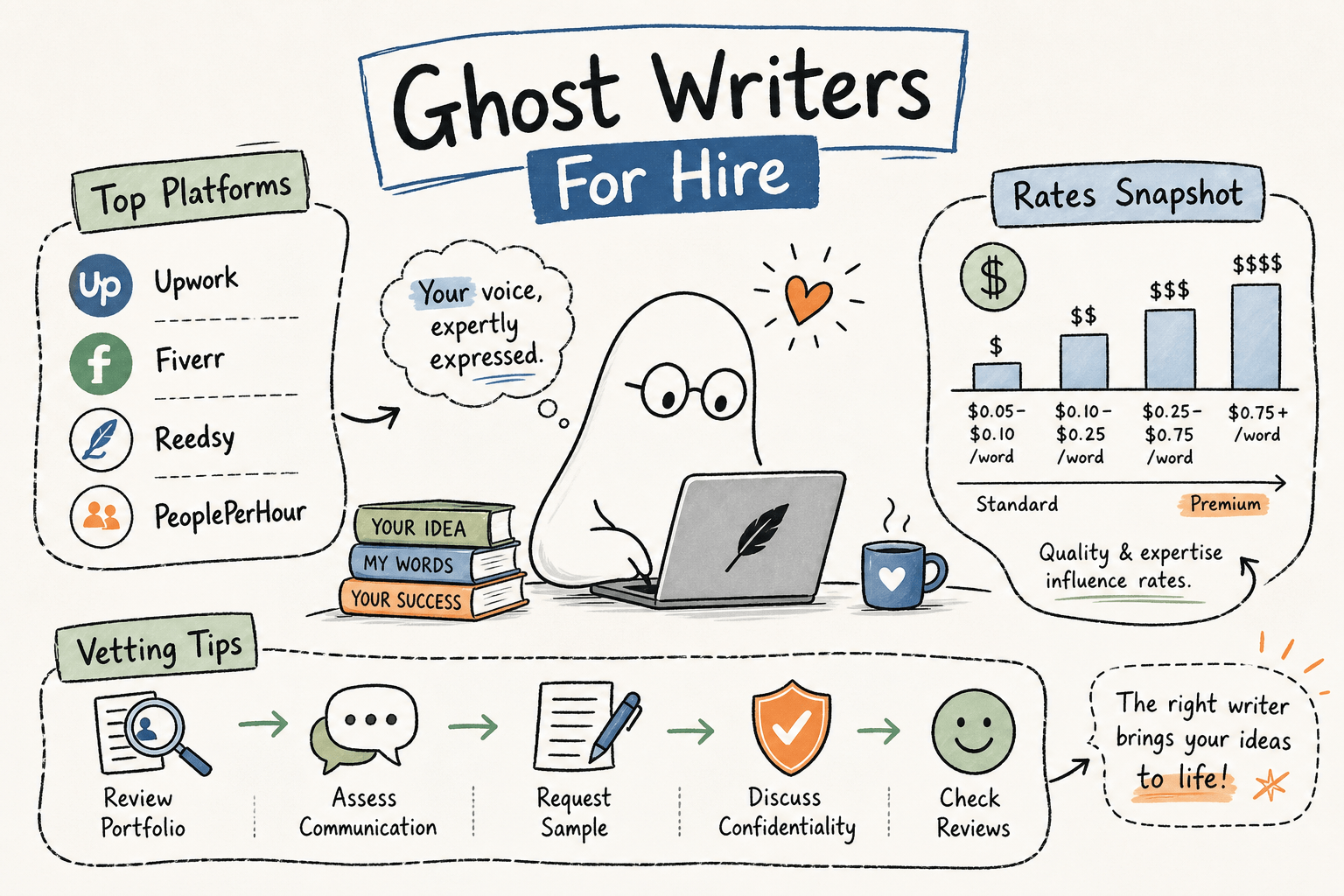
Finding ghost writers for hire is more straightforward than it used to be. Demand is strong and growing, which means the gap between a great hire and a costly mistake often comes down to where and how you search. This guide gives you a clear breakdown of platform types, realistic pricing, a practical vetting checklist, and the contract clauses that protect you from day one.
At Bridge Publisher, we match authors with vetted book ghostwriters and manage the process through final manuscript and launch. If you want a partner that handles the interviews, outline, drafts, and revisions with accountability, you will see how a curated service saves time and reduces risk. If you prefer to compare marketplaces yourself, you will find honest guidance below.
By the end, you will know which platforms fit your project, what budget to plan for, how to evaluate writers like a pro, and what to put in writing before you start. Here is everything you need to make that call with confidence.
Not all ghostwriting platforms work the same way
Freelance marketplaces: you do your own vetting
Platforms like Upwork, Fiverr, and Freelancer open the door to hundreds of profiles across genres and budgets. Reviews and ratings are useful, but they tend to focus on outcomes rather than process details, things like voice-capture methods or how a writer handles scope drift mid-project. The tradeoff is control for effort: you can hire quickly, but you own the screening.
These platforms work best for shorter projects, tighter budgets, or clients who already know how to evaluate portfolios and run structured interviews. If you are comfortable with hands-on management and structured evaluation, this route delivers value.
Curated agencies and full-service publishers
Curated services pre-screen writers, verify track records, and typically specialize in book-length work. You pay more up front, but you skip the open-call chaos and get a managed process with milestone accountability. For a memoir, business book, or novel, this structure often saves time and, depending on rework risk and project complexity, can reduce overall costs.
This is where Bridge Publisher fits. We match you to a ghostwriter with proven results in your genre, run voice sessions, schedule interviews, manage drafts, and keep the timeline moving without guesswork.
Which model suits your project
Short articles and compact ebooks can work well on general marketplaces. Full-length memoirs, business books, and novels benefit from a curated bench, editorial oversight, and a defined workflow.
Your time and risk tolerance drive the choice. If you cannot afford a false start, choose a managed option. If you have bandwidth to compare candidates and steer the process, a marketplace can get the job done.
Where to hire ghost writers: platform-by-platform breakdown
Curated and book-focused options
Bridge Publisher offers fully integrated ghostwriting services across memoir, business, self-help, and fiction. Rather than browsing profiles, you are matched to a writer based on genre, voice, scope, and timeline, then supported through outline, drafting, revisions, and handoff to editing and launch, a strong fit if you want professional results without building the process yourself.
Reedsy is a publishing-focused marketplace with strict vetting and verified track records. Many of its writers have co-authored notable titles, and rates typically start around $3,500 for fiction and $6,500 or more for nonfiction, with full book projects rising well above those baselines. Bridge Publisher extends that level of vetting by pairing writer selection with active project management and downstream publishing support in one integrated service.
General freelance platforms
Budget-conscious authors often turn to Upwork and Fiverr for short-form projects. Upwork writers commonly earn $20 to $45 per hour; Fiverr operates on packaged gigs with tiered pricing. Vetting relies primarily on client reviews and profile verification, so diligence on your end is essential.
Guru and Freelancer operate on competitive bidding with milestone payments you control. They work well when you want to post a brief, compare proposals, and manage the schedule tightly yourself.
Specialized content platforms
WriterAccess and Verblio serve ongoing content needs like blogs and marketing articles. Verblio starts near $40 for 300 words, which suits small deliverables but not a 60,000-word manuscript. Scripted is similar in focus and fits recurring ghostwritten content more than one-time books.
If you are commissioning a full book, choose a curated book platform or a full-service partner. Content networks shine for repeat articles, newsletters, and marketing assets.
What ghostwriting actually costs: a realistic look at rates
Rates by project type
Memoirs and personal books typically run $20,000 to $75,000 or more depending on length, complexity, and the writer’s credentials. A common professional range for a full manuscript is $20,000 to $40,000. Business books around 50,000 words often fall between $15,000 and $40,000 when the scope is defined and interview time is efficient.
Novels often use per-word pricing. Based on current marketplace data, entry-level writers charge roughly $0.05 to $0.10 per word, established writers $0.10 to $0.25 per word, and top-tier professionals above that range. Articles and ebooks run from $1,500 to $15,000 based on depth, research, and deliverables beyond the writing itself.
The three pricing models explained
Per-word pricing gives cost predictability, but it requires a clear word-count range and agreement on what counts toward that number. Hourly rates from $30 to $250 suit exploratory scopes and advisory time, though they demand strict time tracking and regular summaries. Flat fees align best with defined book deliverables and allow milestone-based payments.
Most experienced book ghostwriters prefer flat or milestone arrangements. Plan for four stages: outline completion, first half of draft, full first draft, and final manuscript, each with review windows and sign-offs built in.
What pushes the price higher
Specialized domains like medical, legal, or finance require deeper research and review, which raises fees. Tight deadlines, executive availability constraints, and heavy confidentiality requirements also increase costs. Projects that grant no public credit to the ghostwriter typically command a premium, since the writer cannot add the work to a portfolio, a factor worth discussing openly during negotiations to understand how much it affects the quote.
How to vet a ghostwriter before you commit
What a strong portfolio actually looks like
Confidentiality limits what many professionals can share openly, so look for detailed anonymized case studies rather than polished excerpts. You want scope, genre, word count, timeline, collaboration details, and measurable outcomes or client feedback. Case studies that demonstrate multiple distinct voices signal adaptability; samples that all read the same way are a warning sign.
Client testimonials carry the most weight when they speak to process reliability, responsiveness, and revision quality. General praise without specifics tells you little about how the work actually got done.
Interview questions worth asking
Ask candidates to walk you through their voice-capture process: number and length of interviews, intake questionnaires, and how they monitor voice drift across chapters. Probe how they manage scope changes, missed deadlines, and feedback cycles. Listen for clear procedures rather than vague reassurances. Clarify research expectations, source handling, and how they integrate materials you provide.
Confirm timelines, availability, and who will actually write the book. Insist on disclosure about subcontracting to protect voice consistency and accountability.
The case for a paid test assignment
A short paid test, typically 1,000 words or more written in your voice, reveals more than hours of interviews. It tests chemistry, comprehension, and quality under a real brief. A lower word count (around 500 words) can work if budget is tight, but a longer sample gives a clearer read on voice consistency. If a writer resists a reasonable paid test, note it carefully and continue comparing options.
- Quick vetting checklist:
- Review anonymized case studies that include scope and outcomes.
- Confirm a voice-capture process in writing.
- Align on timeline and availability before proceeding.
- Agree on scope, milestones, and revision limits.
- Sign an NDA before sharing any materials.
- Run a paid test before committing to the full manuscript.
Contract terms that protect you from day one
Copyright and ownership: the foundation you cannot skip
Every ghostwriting agreement should state the work is created as work-for-hire with full copyright transfer to you upon final payment. The writer retains no rights to publish, claim authorship, or add the work to a portfolio without your written permission. Include derivative rights, film, translations, artwork, in the transfer language, and consider a moral-rights waiver where applicable.
Clients should require work-for-hire language or an explicit copyright transfer tied to final payment. Confirm enforceability with legal counsel, because some jurisdictions retain moral rights that a contract clause alone may not override. Tying transfer to payment preserves your leverage at the close of the project.
Payment milestones and revision limits
Use milestone-based payments tied to four deliverables: outline, first half of draft, complete first draft, and final manuscript. Define a word-count tolerance, typically plus or minus 10 percent, and a 30-day payment window per invoice. Many contracts cap revisions at two or three rounds per phase with defined turnaround windows; the right number for your project depends on scope and complexity, so treat this as a starting point for negotiation rather than a fixed rule.
For standard nonfiction timelines, expect 4 to 8 months depending on length and research requirements. Rush schedules are possible at premium rates and with greater author availability.
NDAs, kill fees, and termination clauses
Include a strict confidentiality clause that prevents the writer from disclosing the project, even anonymously, without your consent. Add a fair kill fee for client-initiated termination and spell out how completed work is handed off. Prohibit subcontracting without written approval so the vetted writer you hired is the one doing the work.
- Contract essentials to include:
- Work-for-hire copyright transfer with derivative rights coverage.
- Clear scope of work and deliverables.
- Four milestone payments with word-count tolerance.
- Revision limits with defined turnaround windows.
- NDA and data handling terms.
- Originality warranties.
- No subcontracting without written approval.
- Kill fee and mutual termination process.
Hiring ghost writers: your next steps
You now have four clear decisions to make with confidence: choose the platform model that fits your scope, estimate a realistic budget, run a structured vetting process, and insist on the contract clauses that protect your rights and timeline. Platform choice sets the tone for everything that follows. Marketplaces demand hands-on screening and management, while curated partners absorb the complexity and keep momentum steady.
If you want professional results without building the process from scratch, Bridge Publisher will match you with a vetted book ghostwriter and manage every milestone through final manuscript. When you are ready to move from researching ghostwriters to committing to the right one, start with a discovery call and a brief that clarifies scope, voice, and outcomes. We will meet you there with a plan.

