

Blog
Ghost Writing Book in Phasmophobia: Tiers & Placement

In real life, ghostwriting is a collaborative process where a team like Bridge Publisher quietly turns your story into a polished manuscript. In Phasmophobia, the ghost does the writing, and the Ghost Writing Book records it all. That two-word distinction matters: the Ghost Writing Book is the in-game evidence tool, and it tells you more than it first appears.
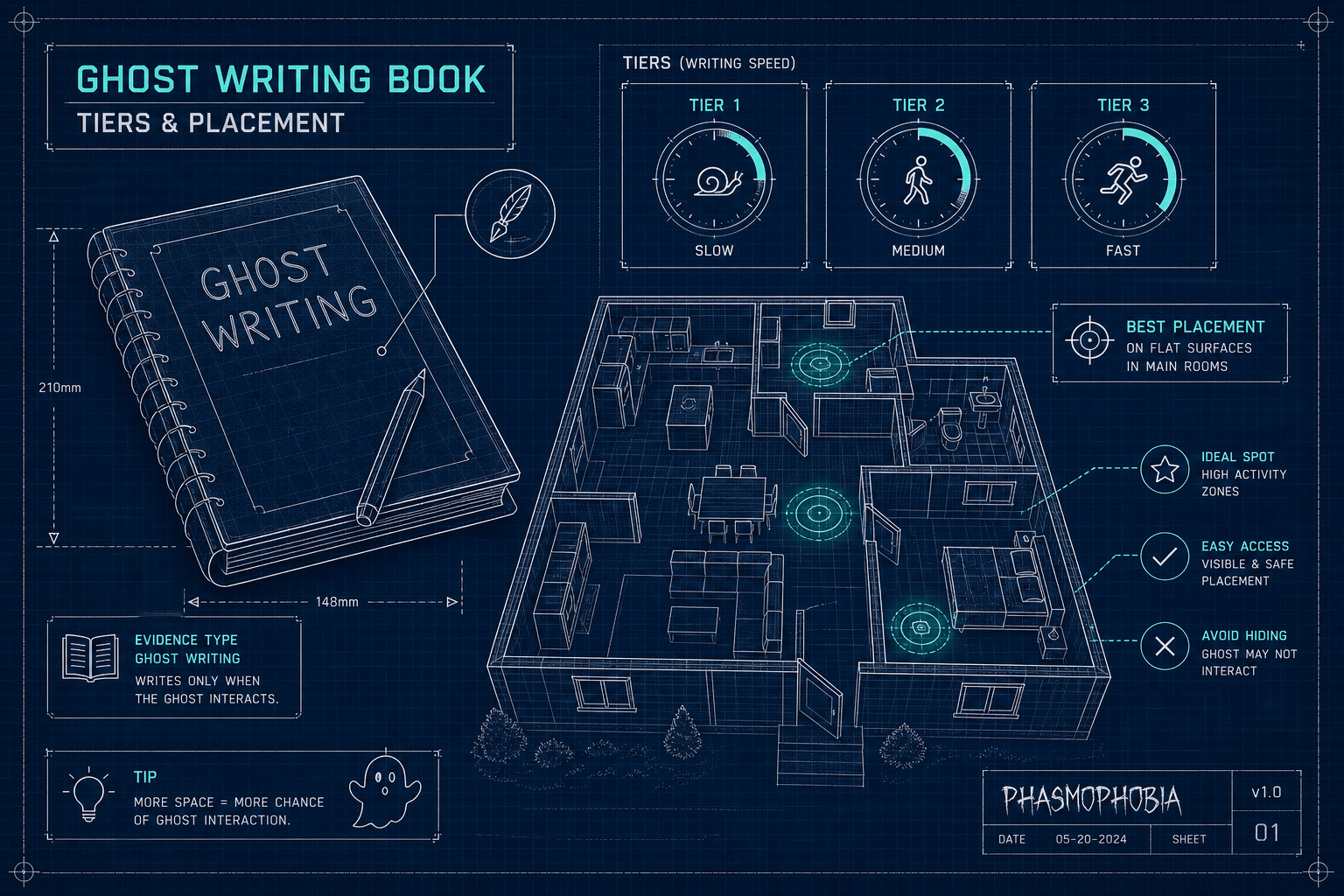
The Ghost Writing Book is one of Phasmophobia’s most passive evidence tools. You place it, wait, and let the ghost come to it. When a ghost with ghost writing in its evidence set interacts with your opened book, the book levitates, displays frantic scribbling, and confirms evidence. Placement, timing, and tier selection make a measurable difference in how fast you get that confirmation, we’re talking a jump from 50% interaction success at Tier 1 to 75% at Tier 3, across a range expanding from 3 to 5 meters.
This guide covers exactly how the book registers evidence, which ghost types can produce it, how to place the Ghost Writing Book for maximum results, what changes between tiers, and how to troubleshoot when the ghost just won’t cooperate.
How the Ghost Writing Book registers evidence
The core mechanic is straightforward. When a ghost interacts with an opened Ghost Writing Book within its range, the book rises off the surface and displays visible, frantic scribbling. That animation is your confirmation: ghost writing is one of this ghost’s three pieces of evidence.
Every successful writing interaction automatically generates an EMF Level 2 reading. If EMF Level 5 is also in the ghost’s evidence profile, there is a 33% chance the interaction produces an EMF 5 reading instead. (These interaction behaviors are documented in the game’s patch notes and community wikis; verify against the current 2026 build if you’re playing after a major update.) One thing worth knowing upfront: the style of writing, whether scribbles, symbols, or recognizable words, does not narrow down the ghost type further. Writing appearing at all is the evidence. The content of what’s written is flavor.
How the evidence interaction plays out
When the ghost writes, you’ll see the book rise slightly off the surface, hear scribbling sounds, and notice the pen or pencil thrown nearby. If you’re monitoring remotely, a video camera angled at the book from roughly 90 degrees gives you a clear view of the levitation and scribbling from the safety of the truck, a community-standard practice that keeps you out of danger while still catching the event on video.
The EMF overlap and why it matters
Because every ghost writing interaction produces at least EMF Level 2, you’re getting two data points from one event. If your EMF reader spikes to Level 5 during or right after the book is written in, that’s strong evidence pointing toward EMF 5 as the ghost’s second piece. Ghost writing and EMF 5 share evidence profiles with Spirit, Shade, and Myling, so a Level 5 spike alongside writing can cut your suspect list significantly. Use this overlap deliberately rather than treating each tool in isolation.
Which ghost types can produce ghost writing
Not every ghost in Phasmophobia writes. If you place the book in the ghost’s room and it never interacts, or actively throws the book without writing, that’s useful information on its own. Knowing which ghost types are capable of ghost writing helps you build your evidence picture faster and stops you from waiting indefinitely for something that was never going to happen.
Ghost Writing Book evidence: the full ghost type list
Based on documented evidence pools (note: Phasmophobia’s ghost roster expanded to 27 types in 2025, 2026; verify this list against current patch notes, as evidence assignments can shift between updates). Each entry below shows ghost writing alongside the ghost’s other two evidence types:
- Demon: Ghost Writing, Freezing Temperatures, Fingerprints (UV)
- Mare: Ghost Writing, Spirit Box, Ghost Orbs
- Myling: Ghost Writing, EMF Level 5, Ultraviolet
- Obake: Ghost Writing, Ultraviolet, D.O.T.S. Projector
- Poltergeist: Ghost Writing, Ultraviolet, Spirit Box
- Revenant: Ghost Writing, Freezing Temperatures, Ghost Orbs
- Shade: Ghost Writing, EMF Level 5, Freezing Temperatures
- Spirit: Ghost Writing, EMF Level 5, Spirit Box
- Thaye: Ghost Writing, Ghost Orbs, D.O.T.S. Projector
When you confirm ghost writing, you’re already narrowing the pool to these types. Cross-reference the other evidence you’ve gathered to close in on the specific ghost faster. Confirmed Ghost Orbs alongside writing, for example, leaves you with Mare, Revenant, or Thaye.
What it means when the ghost throws or closes the book
A ghost that knocks the book off a surface or closes it without writing is telling you something useful. Ghost writing is not in that ghost’s evidence set. This eliminates the ghost types above and points you toward the remaining pool. The book is a dual-purpose tool: it confirms ghost writing when writing appears, and eliminates it when the ghost interacts without writing. Neither outcome is wasted time.
Where and how to place the Ghost Writing Book for maximum results
Placement is where most players lose time. The single most common mistake is dropping the book rather than placing it. A dropped book won’t receive any writing, regardless of how long it sits there. Use the Secondary Interact button (F on PC, LT or L2 on console) to open and properly place the book on a surface, that’s the reliable method. Worth noting: an already-opened book that you’re actively holding can still register a writing interaction, but placing it via Secondary Interact on a surface is the recommended approach for consistent results.
Finding the right room and positioning
Put the book in the ghost’s favorite room or wherever activity is concentrated. The ghost has to be physically within the book’s active range for an interaction attempt to occur. When you’re in placement mode, a white circle appears indicating the book’s coverage area. Center it in smaller rooms to maximize the chance the ghost passes through range during its wandering. Placing it in a corner along a wall reduces that coverage unnecessarily.
Using multiple books and camera monitoring
For larger rooms, two books positioned apart can cover the full area rather than stacking them on the same surface where they duplicate coverage. The camera monitoring approach is worth setting up on any investigation: angle a video camera at 90 degrees facing the book so you can confirm writing from the truck. This is especially useful during active hunts when staying inside isn’t viable and you still want to catch a writing event on video.
How room clutter affects interaction rate
The ghost selects from all interactive objects in the room when deciding what to interact with. Removing non-essential items from the ghost room increases the probability the book gets chosen. If you’re racing to confirm ghost writing early in an investigation, clear out objects you don’t need and give the book less competition. On shorter investigation timers, this is a small but meaningful optimization.
Ghost Writing Book tiers: what changes between Tier 1, 2, and 3
After Progression 2.0, the Ghost Writing Book comes in three tiers unlocked through player levels. The differences between tiers are not cosmetic. Range, interaction success rate, and writing pattern variety all change meaningfully, and higher tiers produce results noticeably faster in practice.
Tier 1: the spiral notebook
Tier 1 is a small spiral notebook with a pencil. Its active range is roughly 3 meters, and each interaction attempt has a 50% chance of producing writing. It also has the fewest writing patterns, mostly scribbles that can be harder to read after the pencil is thrown. In a small room like a bathroom or single bedroom, Tier 1 works fine. Place it the moment you identify ghost activity and give it as much time as possible, because at 50% per attempt every 45 to 90 seconds, you may wait several cycles before writing appears.
Tier 2: the leatherbound journal
Tier 2 expands range to roughly 4 meters and raises the interaction success rate to 66.67%. It also introduces six distinct writing patterns, including a couple of Easter eggs worth noticing. Tier 2 covers small-to-medium rooms comfortably and strikes a solid balance for most standard investigation maps. The jump from Tier 1 is meaningful enough that it’s worth unlocking early in your progression.
Tier 3: the grimoire
Tier 3 is a large grimoire with a 5-meter range and a 75% interaction success rate. Its writing patterns are more distinct and visually varied than Tier 1. On large maps with wide rooms or long corridors, Tier 3 is the clear choice. The combination of extended range and higher interaction rate makes evidence confirmation significantly faster than the lower tiers. If you’re deciding which equipment to prioritize, Tier 3 of the Ghost Writing Book should be high on your list.
Conditions that affect whether the ghost writes
A common assumption is that high EMF activity, freezing temperatures, or low sanity push the ghost toward writing more frequently. None of those factors directly influence ghost writing interactions. The actual mechanics are straightforward, there’s no trick to “triggering” writing beyond getting the fundamentals right.
Proximity is the only hard requirement
The ghost must be within the book’s active range when an interaction attempt triggers, and ghost writing must be part of that ghost’s evidence set. Those are the two non-random requirements. Freezing temperatures, EMF spikes, and sanity levels don’t change the writing probability. They’re useful for gathering other evidence, but they won’t make the book write faster. Chasing conditions that don’t matter wastes investigation time you’d spend better on placement confirmation.
Interaction timing and what “45 to 90 seconds” actually means
The ghost attempts to interact with the book every 45 to 90 seconds, and the timer starts when the equipment is loaded. Each attempt isn’t guaranteed to produce writing: the tier’s success rate applies per attempt. A Tier 1 book at 50% success could take several attempts and several minutes before writing appears. Set the book early and resist the urge to pull and recheck it constantly.
Picking the book up to inspect it resets its position and can cause you to miss a near-attempt entirely. Let the timer run.
Troubleshooting when the ghost won’t write
The book has been sitting there for five minutes and nothing happened
Run through the checklist before assuming ghost writing isn’t evidence. Is the book open and properly placed rather than dropped? Is this actually the ghost’s confirmed favorite room, or did you place the book before narrowing ghost activity? Is the book centered within range, or sitting near the edge where the ghost rarely passes? Has another piece of evidence already made ghost writing unlikely for the types still in your pool? Each scenario has a direct fix: reconfirm ghost location, reposition the book, and cross-reference your current evidence list before pulling it.
Common mistakes that waste time
The most time-consuming mistake is placing the book before confirming ghost activity in a specific room, you’re burning investigation time in the wrong location entirely. Dropping instead of placing is the next one: a dropped book never receives writing regardless of how long it sits there. The mistake that’s easiest to miss is timing: ghost writing does not occur during active hunt phases. If you place the book during or just before a hunt starts, you’ll need to wait for the hunt to end before any interaction attempt can succeed. Time your placement during calm investigation phases and you’ll get results consistently faster.
What the book tells you either way
The Ghost Writing Book rewards patience and precision more than most evidence tools in Phasmophobia. Place it correctly in the confirmed ghost room, match the tier to your map size, and give it enough time to register before drawing conclusions. When the book writes, you’ve confirmed one of the ghost writing types and likely picked up a secondary EMF data point at the same time. When a ghost interacts without writing, you’ve eliminated those types entirely.
The real skill with Phasmophobia ghost writing evidence is reading absence as clearly as presence. A ghost that throws or closes the book is cooperating with your investigation just as much as one that scribbles across the page. Keep your placement deliberate, your tier selection intentional, and your patience intact while the timer runs its course.
One final note: Phasmophobia’s ghost evidence pools and interaction rates have shifted between updates more than once. Check the latest patch notes after any major update to confirm that interaction chances and ghost evidence assignments still match what’s documented here. The mechanics described reflect current documented behavior as of 2026, but Kinetic Games adjusts them regularly, staying current with patch notes keeps your investigation strategies accurate.
Frequently asked questions: how to use the Ghost Writing Book
How do I get the ghost writing book to work in Phasmophobia?
Open and place the book on a surface using the Secondary Interact button (F on PC, LT/L2 on console) in the ghost’s active room. A dropped book won’t register writing. Once placed, give it time, the ghost attempts an interaction every 45 to 90 seconds, and success isn’t guaranteed on every attempt.
Does Phasmophobia ghost writing require any special conditions?
No special conditions. The ghost just needs to be within the book’s active range and have ghost writing in its evidence set. EMF levels, sanity, and temperature don’t affect how often the book gets written in.
What’s the difference between Phasmophobia bookkeeping strategies across tiers?
Tier 1 covers about 3 meters at 50% success per attempt. Tier 2 reaches 4 meters at 66.67%. Tier 3 extends to 5 meters at 75%. On larger maps, the range difference matters more than the success rate difference; on smaller maps, any tier works.

