

Blog
How to find the right book ghostwriter (and avoid bad ones)

Julie Clark’s instant New York Times bestseller The Ghostwriter, released June 3, 2025, opens with a professional ghostwriter named Olivia Dumont taking a job she can’t afford to turn down. If you’re searching for a book ghostwriter yourself, Olivia’s story is a useful cautionary tale. Her client is Vincent Taylor, a famous horror novelist and the estranged father she’s spent her career hiding from. The project is supposed to be his final novel. It isn’t. It’s a memoir full of buried truths about a 1975 family tragedy that Vincent has spent five decades concealing. Clark’s thriller is available in hardcover ($27.99) and paperback ($18.99) from Sourcebooks, stocked widely at Amazon, Barnes & Noble, Books-A-Million, and Bookshop.org. Audiobook and ebook editions are also available through major digital platforms.
The novel works as fiction, but it also captures something true about ghostwriting as a profession: the relationship depends entirely on honesty. In the reviewer’s reading, that’s not a literary observation, it’s a structural fact about how these engagements succeed or fail. Olivia doesn’t ask enough questions before she accepts the job. She doesn’t know what she’s actually being hired to write, who the real audience is, or what her father plans to do with the finished manuscript. That breakdown of transparency drives the tension from the first chapter to the last.
Real ghostwriting engagements don’t come with hidden memoirs and buried family secrets, though due diligence matters because scope, source material, and confidentiality terms vary significantly from project to project. Hiring the wrong book ghostwriter can cost you thousands of dollars, months of time, and the integrity of your own story. At Bridge Publisher, the entire author intake process is designed around reducing that risk, matching authors with proven ghostwriters through a structured, transparent system built to protect your story and your investment.
What a book ghostwriter actually does (and what they don’t)
The real scope of a ghostwriting engagement
A professional book ghostwriter is not a co-author, and they’re not an editor. Their job is to take your ideas, expertise, and voice and shape them into a publishable manuscript. That means conducting interviews, building narrative structure, developing chapters from outlines or transcripts, and delivering draft content ready for the editing phase. The story belongs to you from start to finish. The ghostwriter is the skilled craftsperson who puts it on the page.
What a ghostwriter shouldn’t do is override your perspective with their own. They may help develop structure, suggest narrative approaches, or contribute organizational ideas, but always in service of your vision, not theirs. A ghostwriter who consistently pushes their own creative agenda ahead of yours is misunderstanding the job.
How voice preservation works in practice
The best ghostwriters start every engagement with a structured discovery phase designed to capture your voice. This typically includes in-depth interviews, writing samples from the author, tone questionnaires, and chapter-by-chapter feedback loops during the early drafts. The goal is a manuscript that sounds like you at your most articulate, not like someone else’s interpretation of your ideas.
A skilled ghost captures not just what you’re saying but how you say it: the rhythm of your sentences, the words you reach for naturally, the level of formality you’re comfortable with. If you read the finished manuscript and it doesn’t sound like you, the discovery phase wasn’t done right.
Confidentiality and authorship rights
Most professional ghostwriting engagements include a contract that transfers all copyright to the author and covers a strict non-disclosure agreement. Authors should ensure their contracts explicitly specify copyright transfer, confidentiality terms, and credit and royalty clauses before signing. If a ghostwriter hesitates on any of these points, that hesitation is your answer. Public credit, royalty claims, and disclosure of the working relationship should all be addressed clearly in writing, that’s a baseline expectation, not a negotiating point.
How to choose a book ghostwriter: questions that reveal true fit
Questions about experience and genre knowledge
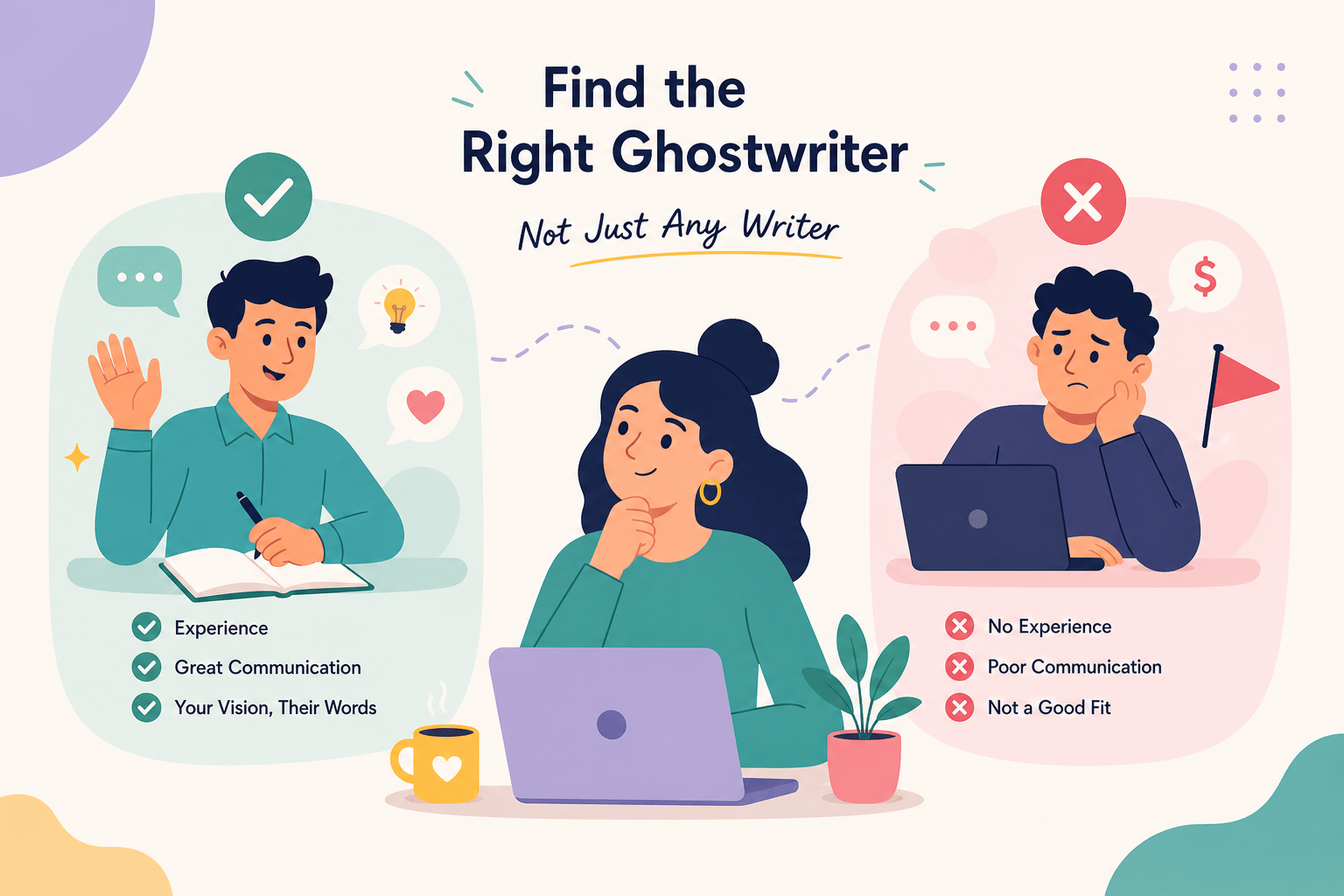
Start by asking about their completed manuscripts in your specific genre. Not manuscripts they started, not general writing samples. Ask how many full-length books they’ve delivered and what genres those books fell into. A ghostwriter with a strong track record in business books may struggle badly with a personal memoir, the emotional register and structural demands are completely different.
Request samples that match your genre as closely as possible. If every sample they send sounds like the same person regardless of the stated author, you have a problem. A ghostwriter’s portfolio should demonstrate range, not just quality.
Questions about process, timelines, and revision cycles
A serious ghostwriter can walk you through their process without hesitation. Ask how they structure their discovery phase, how many revision rounds are included in their rate, and what happens if the project stalls or the relationship breaks down mid-manuscript. A ghostwriter who gives vague or defensive answers to process questions is telling you they don’t have a reliable process. That means your project becomes their experiment.
Timelines matter too. A full manuscript takes months of interviews, drafts, and revisions. Anyone who promises a fast turnaround without asking detailed questions about scope is underestimating the work.
What a strong portfolio should show you
You’re not just evaluating writing quality. You’re evaluating adaptability. Look for range of voice across different samples and narrative consistency within a single project. Then ask yourself whether the story moves forward with clarity and purpose. If every sample carries the same sentence rhythm and the same stylistic fingerprints regardless of genre or author, the ghostwriter isn’t adapting. They’re writing every project in their own voice, and that’s not what you’re paying for.
Red flags to watch before you sign anything
Vague contracts and undefined deliverables
A contract that doesn’t specify word count targets, revision rounds, milestone deadlines, and rights transfer language is not protecting you. Every deliverable should be named, every deadline should be dated, and the rights transfer clause should be explicit. If a ghostwriter pushes back on formalizing these details, that refusal tells you more than any portfolio sample could.
Book ghostwriter pricing: what low rates actually signal
Professional ghostwriting is a premium service, one that typically requires many months of sustained work to execute well. Unusually low rates often signal inexperience, subcontracted work, or shortcuts on revisions. High rates don’t automatically mean quality, but low rates almost always mean risk. Compare pricing against the portfolio and the stated process, not against what you were hoping to spend.
Ghostwriters who skip the discovery phase
Any ghost worth hiring wants to understand your voice, your goals, and your story before they quote you a price. If someone sends you a project estimate after a five-minute call and wants to start immediately, the manuscript they deliver will reflect exactly that level of attention. The discovery phase is where voice fidelity is built. Skipping it means the ghostwriter is more focused on starting the billing clock than on writing your book.
How Bridge Publisher’s vetting process protects authors
What the screening process looks like
At Bridge Publisher, we don’t recruit freelance writers and hand them author projects. Each ghostwriter in our network is evaluated on genre experience, portfolio quality, process clarity, communication standards, and revision track record before any author introductions are made. We run a structured intake that mirrors exactly what a careful author should be doing independently, and we only bring ghostwriters into the roster when they clear each checkpoint. The result is a curated network of professionals matched to projects based on proven fit, not availability.
How author-ghostwriter matching actually works
The process starts with your project. We begin with an author intake call to understand your book’s genre, tone, target audience, and your working style. We use that information to identify ghostwriters whose track record, voice range, and communication approach align with what your manuscript needs. Before any contract is signed, we introduce you to your matched ghostwriter so you can evaluate fit and chemistry in a real conversation. You’re not locked into a working relationship without knowing who you’re working with first.
Built-in accountability throughout the manuscript
Bridge Publisher doesn’t disappear after the match is made. We maintain editorial oversight throughout the engagement, with milestone reviews, draft approvals, and direct access to your project team at every stage. If something isn’t working, you have a publishing partner in your corner rather than a freelance contract and no safety net. That structure keeps quality, timelines, and voice fidelity on track through every phase of the manuscript.
Making the final hiring decision with confidence
Why a trial chapter is worth requesting
Before committing to a full manuscript, ask for a paid trial chapter. Most established ghostwriters will agree to this before a full engagement begins, and it’s a legitimate way to test the relationship before months of work are underway. A trial chapter shows you how the ghost interprets your voice, handles your source material, and responds to editorial feedback. The cost is minimal compared to what a mismatched full-length engagement would cost you in time and money.
The role of gut instinct alongside the checklist
You’re going to share your story, your memories, or your professional expertise with this person for months. The quality of communication during the intake stage matters as much as the portfolio. If the ghostwriter seems distracted, transactional, or rushed before the project begins, that dynamic won’t improve once the work starts. Confidence in a hire comes from credentials and from the quality of the conversation. Trust both signals equally.
The right partner makes all the difference
Olivia Dumont takes a ghostwriting job without asking enough questions, and the consequences follow her through every chapter of Julie Clark’s novel. The thriller is fiction, and real ghostwriting engagements don’t involve buried family tragedies or manuscripts designed to deceive. But they do involve your name on the cover, a significant financial commitment, and a story that deserves to be told with precision and care.
Finding the right book ghostwriter comes down to rigor: asking the right questions, reading the right signals, and working with a partner who has already done the vetting for you. Bridge Publisher was built to make that match with confidence, combining a structured screening process, deep genre expertise, and editorial oversight that keeps authors in control at every stage, from the first intake call to the final approved manuscript. If you want a deeper look at why hire a ghostwriter, we outline the core benefits and expectations for authors considering this path.
If you’re ready to turn your idea into a professionally published book, reach out to Bridge Publisher to start a conversation about our best ebook ghostwriting services. Tell us about your project, and we’ll show you exactly how the matching process works.
Frequently asked questions about hiring a book ghostwriter
How much does a book ghostwriter cost?
Book ghostwriter pricing varies widely based on genre, project length, and the writer’s experience level. Entry-level ghostwriters may charge a few thousand dollars, while experienced professionals working on full-length nonfiction or memoir projects often charge significantly more. Treat unusually low quotes as a red flag rather than a bargain, the investment reflects the time and craft required to deliver a publishable manuscript in your voice.
Who owns the book once it’s written?
In a properly structured ghostwriting engagement, copyright transfers entirely to the author upon payment. Authors should confirm this in writing before any work begins. The ghostwriter retains no ownership stake, receives no royalties, and is not credited publicly unless the author chooses to acknowledge them.
How long does it take to write a book with a ghostwriter?
Most full-length manuscripts take between four and twelve months from the initial discovery phase through final draft approval, depending on scope, the author’s availability for interviews and feedback, and the number of revision rounds involved. Be cautious of any ghostwriter who promises a significantly faster timeline without first understanding the full scope of your project.

